 by Joseph

Yes — Canadians and Americans can finance a property in Costa Rica. Foreign buyers have the same ownership rights as citizens under Article 19 of the Constitution, and there are five practical financing routes: a cash-out refinance or HELOC on your home in Canada or the US, seller or developer financing, a mortgage from select Costa Rican banks, a USD investment loan, or simply buying with cash held in escrow. Local bank loans for non-residents typically require 30% to 50% down, so most North American buyers borrow at home and purchase as cash buyers.
Quick Answer: How Do You Finance a Costa Rica Property in 2027?
- Most Canadian and American buyers borrow at home (a HELOC or cash-out refinance) and buy in Costa Rica as cash buyers — usually faster and cheaper than a local mortgage.
- Local bank mortgages exist for foreigners: expect 30–50% down, 15–25 year terms, and USD rates in roughly the 7–11% range as of late 2026 (confirm with each lender; rates change).
- Seller and developer financing is common in our market — usually 25–50% down over short two-to-ten year terms. Villa 41 at Playa Lagarto is currently offered with 50% financing.
- Every route still requires proof of funds, escrow or equivalent secure handling, a notary closing, and the 1.5% real-estate transfer tax on the registered value.
- Do not plan around future rental income: lenders rarely count undocumented Airbnb revenue when qualifying you.
What Are the Five Ways to Finance a Property in Costa Rica?
There is no single “Costa Rican mortgage” product the way there is in Canada or the US. In practice, buyers combine five routes, and the right mix depends on how much equity you hold at home, whether you plan to relocate, and how quickly you want to close. Here is how each route actually works for Canadian and American buyers in 2027.
1) Cash-Out Refinance or HELOC on Your Canadian or US Home
This is the route most of our clients use. You borrow against the equity in your primary home at familiar home-country rates, then wire the proceeds through escrow and buy the Costa Rican property outright. You become a cash buyer: no Costa Rican credit file, no bank approval timelines, and stronger negotiating power on price. The trade-off is that your home remains the collateral, so talk to a cross-border accountant about interest deductibility and reporting before you draw the — our Canada moving guide and US moving guide cover the CRA and IRS side in detail.
2) Seller and Developer Financing
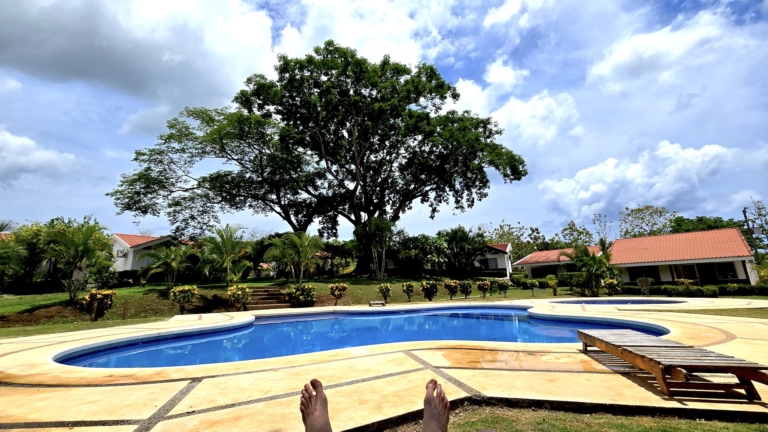
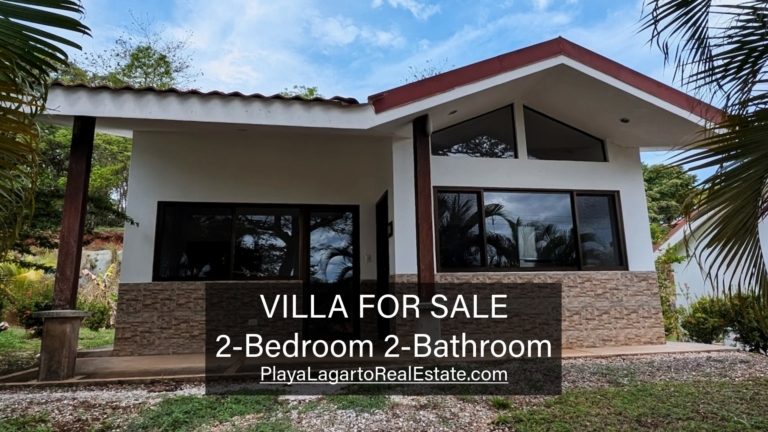
Sellers and developers in Costa Rica often finance part of the price themselves, especially in planned communities. Typical structures ask for 25–50% down with the balance paid over two to ten years, sometimes with a balloon payment at the end. The terms are negotiable and written into the purchase contract. Done properly — lawyer-drafted terms, payments through escrow, clean title — it is a legitimate way to buy with roughly half down. A live example from our own inventory: Villa 41, a furnished villa at Playa Lagarto Eco listed at $169,900, currently offered with 50% financing, which would mean about $84,950 down and $84,950 financed (exact terms available on request).
3) A Mortgage From a Costa Rican Bank or Private Lender
Some Costa Rican banks and private lenders do lend to foreign buyers, but non-resident loans are the exception, not the rule. Where they are available, plan on 30–50% down, terms of roughly 15–25 years, USD interest rates in the 7–11% area as of late 2026, and a slower, document-heavy approval: translated income proof, bank references, an appraisal, and sometimes mandatory life insurance on the loan. Residency status helps a great deal, so buyers planning a permanent move often buy with cash first and finance later, after residency. If you are weighing relocation anyway, start with our relocation guide and the 2025–2028 market overview.
4) USD Lines of Credit, Margin or Investment Loans
Buyers with large investment portfolios sometimes borrow against securities in USD and pay cash for the property. It is fast and requires no Costa Rican bank at all, but rates float and a market dip can trigger a margin call at the worst time. This route suits short holding periods and buyers with a comfortable cushion — it is not a substitute for a mortgage on the property itself.
5) Retirement Accounts — With Restrictions
RRSPs generally cannot directly hold or mortgage foreign real estate, and US 401(k) loans cannot be used for a Costa Rican purchase. A US self-directed IRA can, in some cases, buy foreign property under strict prohibited-transaction rules, but administration is specialized and expensive. Treat this as a niche route that needs a cross-border specialist’s sign-off, not a default plan. For a full picture of what moving money across borders involves, see the foreign buyer guide.
Which Financing Route Is Best? Side-by-Side Comparison
The cheapest money is usually the money you already have access to at home, but the right route also depends on how long you plan to hold and whether you will relocate full-time. This table compares the five routes on the numbers that matter to Canadian and American buyers:
| Financing route | Typical down payment | Typical term | Typical cost | Best for | Watch out for |
|---|---|---|---|---|---|
| HELOC / cash-out refinance at home | None in Costa Rica (equity at home) | 10–30 years | Home-country secured rate | Buyers with equity; fastest closings | Your home is the collateral |
| Seller / developer financing | 25–50% | 2–10 years | Negotiated with seller | Smaller balances; buy-and-build | Short terms and possible balloon payments |
| Costa Rican bank or private mortgage | 30–50% | 15–25 years | ~7–11% USD (late 2026) | Long-term holders, residents | Slow approval; strict income documents |
| USD investment / margin loan | None (secured by portfolio) | Months to years | Floating, varies | Short holds, liquid portfolios | Margin calls in a downturn |
| Cash | 100% | None | None | Strongest offers, simplest closing | Ties up liquidity in one asset |
Ranges are typical for the market as of late 2026 and vary by lender, project and buyer profile; get written quotes before you commit.
What Documents and Proof of Funds Do You Need?
Whether you finance at home or in Costa Rica, the selling side will ask you to prove you can close. Prepare these before you fall in love with a property:
- Proof of funds letter — a bank letter dated within the last 30 days showing available funds; sellers of well-priced listings rarely accept offers without one.
- Income documents for bank or private loans: two years of tax returns, a CPA or accountant letter, and three to six months of bank statements, often translated to Spanish.
- Identification: passport, and if you buy through a Costa Rican company (SRL), apostilled corporate documents.
- Property-side documents: titled (fee simple) property is a prerequisite for bank financing; condominiums must sit in a registered horizontal-property regime.
- Escrow instructions so deposits are held by a neutral licensed party, not by the seller. Cash buyers get the same protection — see the steps in the buyer guide.
What Does a Financed Purchase Actually Cost in 2027?
Financing changes the shape of your cash requirement, but it does not remove the closing costs. On a $200,000 purchase, budget roughly the following beyond your down payment:
| Cost item | Typical amount on a $200,000 purchase | Notes |
|---|---|---|
| Down payment (50% seller-financed example) | $100,000 | Half down is the common structure in financed developments |
| Real-estate transfer tax | $3,000 | 1.5% of the registered value, paid at closing |
| Legal and notary fees | $2,000–$4,000 | Varies by firm; the notary handles the closing itself |
| Escrow fees | $500–$1,500 | Depends on provider and transaction size |
| Bank appraisal (bank loans only) | $300–$500 | The bank orders it |
| Mortgage registration and stamps (bank loans only) | $300–$800 | Registrar fees, roughly a fraction of one percent |
Estimates only — your lawyer provides a written cost sheet before you commit. Add roughly 3.5–4.5% of the purchase price as a planning number for closing costs. Once you own, the holding costs are modest: see our full breakdown of Costa Rica property taxes and HOA fees and the monthly figures in our Costa Rica vs Toronto cost of living comparison.
Properties You Can Finance Right Now: Real 2027 Examples
Financing is only worth discussing when the numbers work on a real property. These are current listings from our own inventory, with prices as of November 1, 2026:

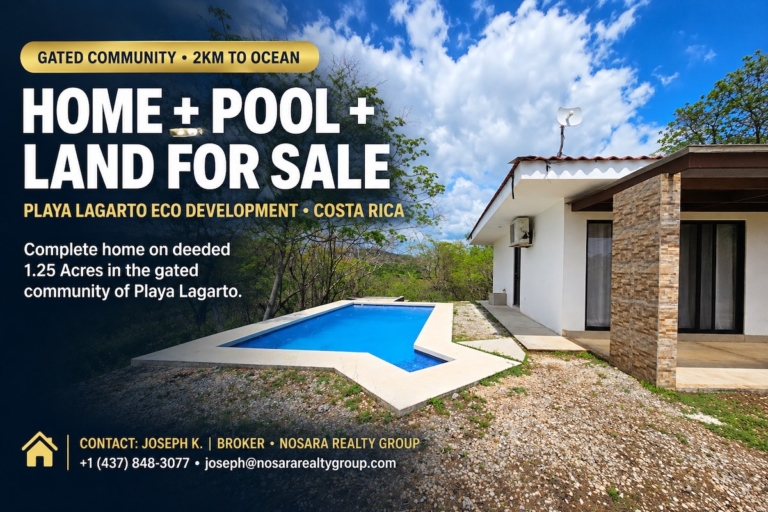
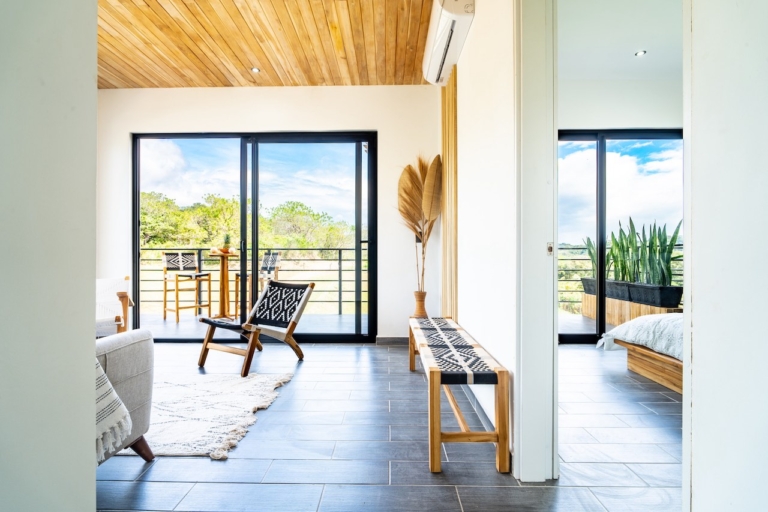
Land buyers can start even smaller: Lot E10 at $49,900 fits many buyers’ savings outright, and House C43, a completed house with 1.25 acres at $169,900, shows what a lot-plus-build budget becomes once finished. Full land pricing is in our Costa Rica land price guide, and rental-income context — without the hype — is in our guide to buying a villa and renting it out.
How Does a Financed Purchase Work, Step by Step?
A financed Costa Rica purchase adds two moving parts to the normal cash closing: the lender’s conditions and the repayment terms. This is the sequence that keeps it clean:
Fix your budget first, including the 3.5–4.5% closing-cost planning number and your contingency cushion.
Get pre-qualified — by your home bank for a HELOC or refinance, or by the Costa Rican lender — and obtain a proof of funds letter.
Choose a titled property and verify the registry folio; banks will not lend on untitled or maritime-zone land.
Negotiate the financing terms into the purchase agreement: down payment, repayment schedule, interest, and what happens if you sell early.
Deposit the down payment into escrow, never directly to the seller.
Run due diligence with your own lawyer: survey (plano catastrado), liens, permits, water and access.
Close at the notary, register the deed and any mortgage, then take possession. Remote buyers close by power of attorney.
Which Financing Mistakes Cost Buyers the Most?
- Wiring money straight to a seller or “the developer’s lawyer.” Use escrow or nothing.
- Assuming your home pre-approval transfers to a Costa Rican bank — it does not; the credit file here starts from zero.
- Signing an unregistered side agreement for seller financing. If it is not in the registered documents, you cannot enforce it.
- Planning the purchase around future Airbnb income. Lenders rarely count it, and occupancy is never guaranteed — see our honest numbers in the best places to live guide.
- Buying at the top of your approval and leaving nothing for furnishings, HOA and the first year’s costs.
Frequently Asked Questions About Financing a Costa Rica Property
Can Americans get a mortgage in Costa Rica?
Yes. Select Costa Rican banks and private lenders lend to American buyers, and approval is easier once you hold residency. Non-residents should expect around 30% to 50% down and USD rates that ran roughly between 7% and 11% in late 2026. Because of those terms, many Americans instead borrow against their home in the US and buy in Costa Rica as a cash buyer.
Can Canadians get a mortgage in Costa Rica?
Yes, with the same conditions: expect 30% to 50% down, strong income documentation, and a slower approval than at home. Anti-money-laundering rules make it harder to open bank accounts as a tourist, which is why most of our Canadian clients use a HELOC or line of credit in Canada, then transfer funds through escrow.
How much is the down payment on a house in Costa Rica?
For a local bank mortgage as a non-resident, typically 30% to 50% of the purchase price. Seller and developer financing usually asks for 50% down. If you borrow against Canadian or US equity instead, the Costa Rican purchase itself is a cash deal and needs no in-country down payment.
Is seller financing safe in Costa Rica?
It can be, when it is done properly: a Costa Rican lawyer drafts the repayment terms into the purchase agreement, the down payment and installments move through escrow, and the seller keeps clear, lien-free title until each payment clears. Never sign an unregistered side deal, and do not wire money straight to a seller.
Can I use my IRA or RRSP to buy property in Costa Rica?
Only within narrow limits. In Canada, RRSPs generally cannot directly hold or mortgage foreign real estate. In the US, a self-directed IRA can sometimes buy foreign property under strict prohibited-transaction rules. Both routes need a cross-border specialist before you rely on them; for most buyers a HELOC is simpler.
Do Costa Rican banks count rental income on a mortgage application?
Rarely. Undocumented Airbnb-style rental income generally does not count toward qualification, so you should qualify on documented income such as pensions, salaries, or investment returns. Do not build your purchase plan around projected rental income covering a mortgage.


🏡 Need Financing Help With a Costa Rica Property?
Whether you are weighing a HELOC from Toronto, seller financing on a Playa Lagarto villa, or a bank mortgage after residency, Yossi Kaplan, MBA works with Canadian and American buyers on the buying side and connects you with vetted lawyers, escrow and lenders. Ask about current financing terms on any listing.